

Text formatting plays a vital role in content readability and structure. Using visual cues like bolding, italicizing, or crossing out text helps highlight key details and guides the reader’s eyes through your document. This guide demonstrates how to apply emphasis formatting in Markdown, when to combine styles, and the best practices for clean syntax.
Key Takeaways
- Bold text by enclosing it in double asterisks (**) or double underscores (__).
- Italicize text by enclosing it in a single asterisk (*) or single underscore (_).
- Combine bold and italic styles using triple asterisks (***) or triple underscores (___).
- Create strikethroughs using double tildes (~~).
How to Bold Text in Markdown?
To bold one or more words, wrap the text with two asterisks ** or two underscores __ on both sides. Do not leave spaces between the formatting symbols and the text.
This is **bold** text.
This is also __bold__ text.
Both styles render identically as bold text. The generated HTML equivalent:
This is <strong>bold</strong> text.How to Italicize Text in Markdown?
To italicize text, wrap it with a single asterisk * or a single underscore _ on both sides.
This is *italicized* text.
This is also _italicized_ text.
Both markers render as italicized text. The generated HTML equivalent:
This is <em>italicized</em> text.While both asterisks and underscores are valid, most modern style guides recommend using asterisks (* and **) for general emphasis. Reserve underscores (_) for when you need to nest formatting or avoid syntax clashes.
How to Combine Bold and Italic Styles?
To apply both bold and italic formatting to the same text simultaneously, wrap the words with three asterisks *** or three underscores ___ on both sides.
This text is ***extremely important***.
This text is ___also extremely important___.
This renders as:
This text is extremely important.
The HTML equivalent generated by the compiler:
This text is <strong><em>extremely important</em></strong>.How to Create Strikethrough Text in Markdown?
A strikethrough draws a horizontal line directly over the text, indicating deleted or obsolete information. In GitHub-Flavored Markdown (GFM), wrap your text in double tildes ~~ on both sides.
The meeting is scheduled for ~~Tuesday~~ Wednesday.This renders as:
The meeting is scheduled for Tuesday Wednesday.
The HTML equivalent:
The meeting is scheduled for <del>Tuesday</del> Wednesday.If you need to apply different types of emphasis close to each other (such as italicizing a word inside a bold sentence), make sure you do not mix the order of the tags.
- Correct:
**This is a _very_ important point.** - Incorrect:
**This is a *very_ important point.**
Summary Checklist
- Use
**or__to bold text. - Use
*or_to italicize text. - Use
***or___to combine bold and italic styles. - Use
~~for GFM strikethroughs. - Keep spacing clean and avoid leaving spaces inside the markers.
Frequently Asked Questions
Which symbol should I prefer for bold and italic?
Asterisks are the default choice in standard Markdown. Underscores are fully supported but can sometimes be harder to read in plain text files, especially when mixed with code snippets.
Can I bold and italicize multiple paragraphs?
No. Standard Markdown emphasis tags do not span across paragraph breaks (blank lines). If you want to bold multiple paragraphs, you must wrap each paragraph individually.
Is strikethrough supported in standard Markdown?
Strikethrough is a feature of GitHub-Flavored Markdown (GFM) and other extended dialects. It is widely supported by modern static site generators and static renderers, but may not compile on very old or basic Markdown parsers.
What to Read Next
- Code Blocks in Markdown - Syntax Highlighting Guide — Learn how to share code inline and format code blocks.
- Tables in Markdown - Create & Format Data — Present structured datasets cleanly with Markdown table styling.
Related Articles
Deepen your understanding with these curated continuations.
Autolinks in Markdown: Bare URLs and Emails
Learn the difference between CommonMark's angle-bracket autolinks and GitHub-Flavored Markdown's extended autolinks for bare URLs and email addresses.

Definition Lists in Markdown
Learn the Markdown Extra-style definition list syntax for terms and descriptions, useful for glossaries and API documentation, plus which tooling supports it.
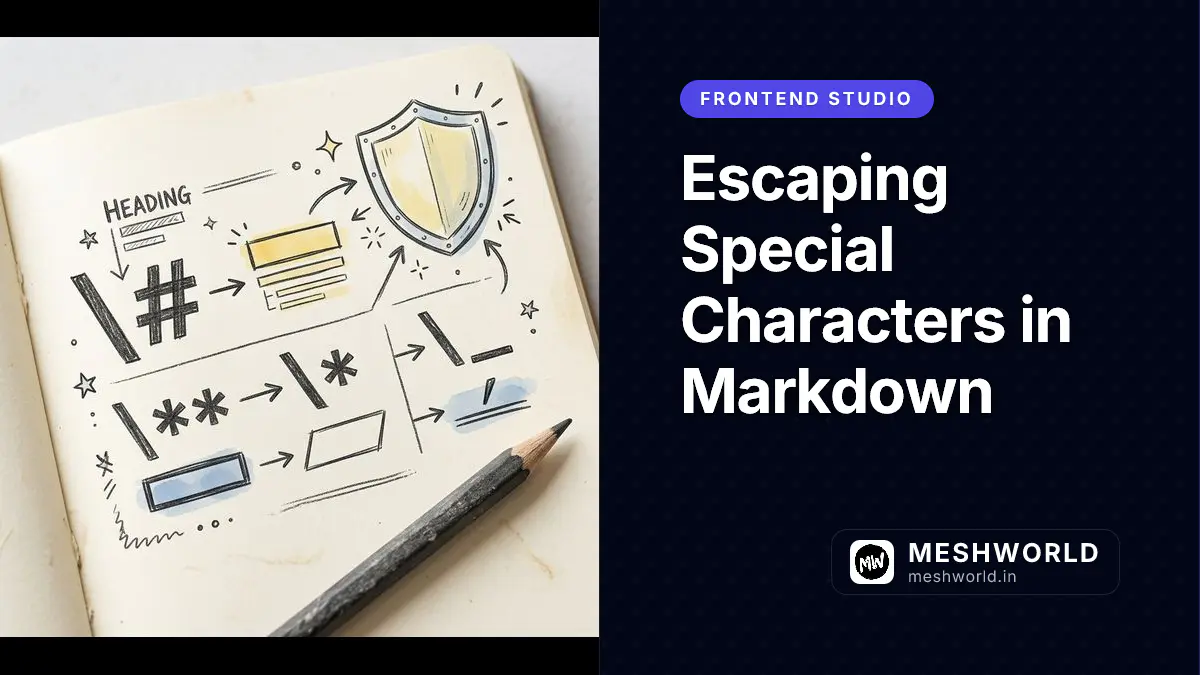
Escaping Special Characters in Markdown
Learn how to escape asterisks, underscores, brackets, and other special characters in Markdown so they display as literal text instead of triggering formatting.


