

Manus AI is a powerful autonomous agent, but its credit-based pricing and cloud-only execution don’t fit every workflow. As of June 2026, the AI agent ecosystem has matured with specialized alternatives for coding, private self-hosting, business automation, and team collaboration. Whether you need Claude’s reasoning, OpenClaw’s local-first privacy, or n8n’s structured workflow reliability, this guide compares the 15 best Manus AI alternatives with pricing, autonomy, privacy, and a 5-step decision framework to help you find your match.
Key Takeaways
- Compare 15 top Manus AI alternatives across autonomy levels, pricing, privacy, and team features.
- ChatGPT Agent (Operator) offers superior reasoning and workspace integration but has strict message caps.
- Claude and Cursor provide industry-standard local coding execution and reasoning, outclassing Manus for software development.
- OpenClaw and AutoGPT are the best free, self-hosted options for users prioritizing data privacy and custom local setups.
- n8n and Zapier remain the most reliable choices for structured, repeatable trigger-action workflows.
Understanding the AI Agent Landscape in 2026
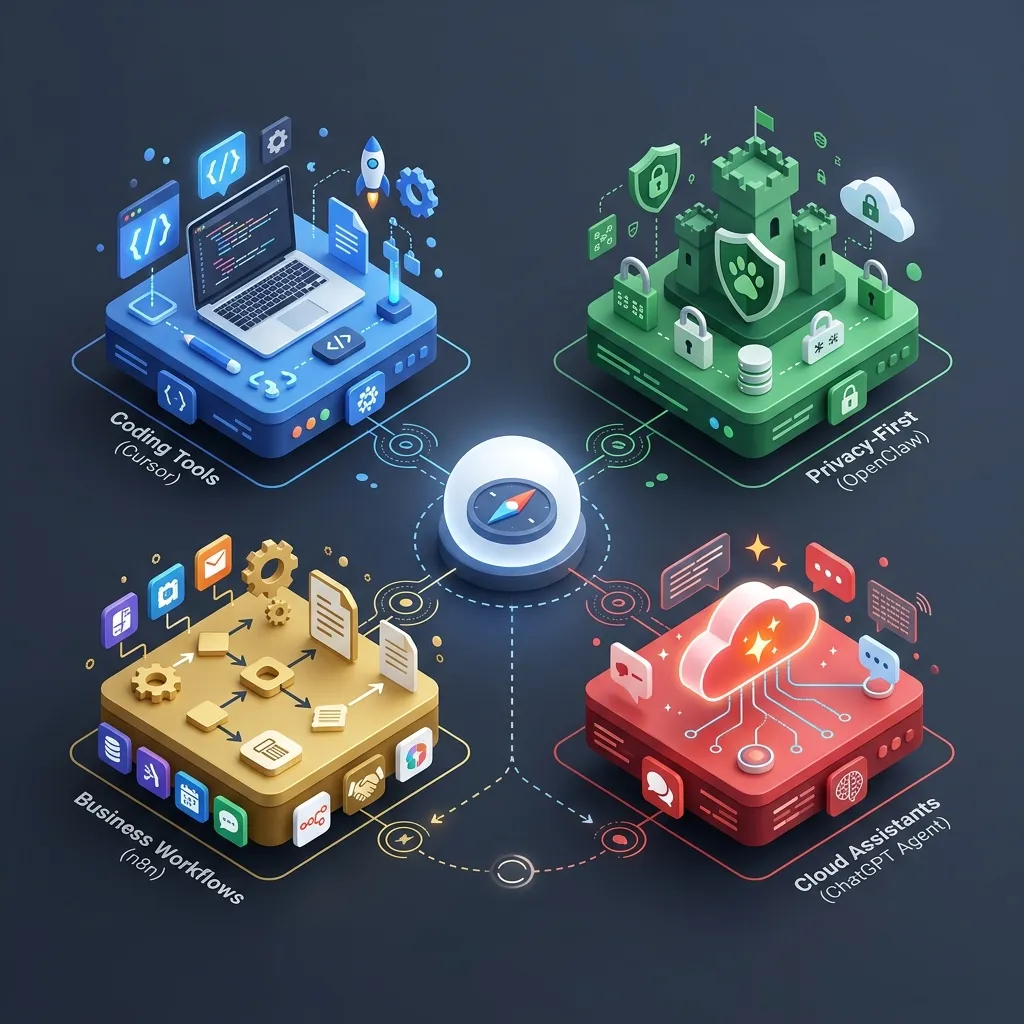
Before diving in, it helps to understand how the market has segmented. AI agents in 2026 generally fall into these categories:
- Autonomous Cloud Agents (like Manus): Operate in sandboxed cloud environments with real browsers and terminals.
- AI-Assisted Development Tools (like Cursor, Bolt): Focus on code generation within familiar IDE environments.
- No-Code AI Workflow Platforms (like Lindy, n8n): Emphasize structured automation across business tools.
- Research-Focused Agents (like Genspark, Perplexity): Specialize in information synthesis and report generation.
- Open-Source Frameworks (like OpenClaw, AutoGPT): Offer maximum flexibility for technical users willing to self-host.
- Enterprise AI Platforms (like Dust): Built for team collaboration, governance, and compliance.
Top 15 Manus AI Alternatives Compared
1. ChatGPT Agent (OpenAI)
OpenAI’s ChatGPT Agent (evolved from the earlier “Operator” feature) is the most formidable general-purpose alternative to Manus AI. Built on GPT-o1 and GPT-5 architecture, it leverages OpenAI’s model infrastructure to reason through complex, multi-step digital workflows with deep ecosystem integration.
-
Autonomous “Computer Use” (CUA): The agent can take over your browser or desktop environment to perform actions like a human would—clicking buttons, scrolling, and filling forms. It scores 32.6% on OSWorld, the gold-standard benchmark for computer use agents.
-
Multi-Agent Orchestration: Multiple agents can work in parallel—one researches while another drafts and a third sends via Gmail.
-
Native App & MCP Integration: Uses the Model Context Protocol to connect directly to GitHub, Google Workspace, Microsoft 365, and thousands of other tools.
-
File Creation: Generates Google Docs, Excel-style spreadsheets, slides, and reports natively.
-
Pricing: Plus Plan ($20/month,
40 agent messages); Pro Plan ($200/month, ~400 agent messages). -
Strengths: Superior reasoning (uses o1-reasoning model to double-check work), better ecosystem integration, and safer confirmation workflows.
-
Weaknesses: Strict usage limits, confirmation overhead (pauses frequently for permission), and web-only sandbox limitations (cannot move files between local desktop apps directly).
-
Best For: Power users already deep in the ChatGPT ecosystem who need heavy cross-app coordination.
2. Claude (Anthropic)
Claude by Anthropic has evolved into a powerful “agentic” AI assistant. While Manus focuses on high-level task automation in isolated cloud environments, Claude blends S-tier reasoning with the ability to execute tasks directly on your computer or within a dedicated workspace.
-
Agentic Computing (Claude Code): Operates as a functional agent that interacts with your local files and terminal to execute commands and manage workflows.
-
Extended Thinking Mode: The Opus model series includes a dedicated reasoning phase where the AI “thinks” through multi-step logic before responding, drastically reducing errors.
-
Massive Context Window: Up to 200,000 tokens (expandable to 1M for enterprise), allowing digestion of entire codebases or 500-page documents without losing context.
-
Model Context Protocol (MCP): Integrates with over 6,000 third-party apps, pulling data from Google Drive, Slack, GitHub, and more.
-
Pricing: Free Plan (limited messages); Pro Plan ($20/month, enhanced access); Team Plan ($30/user/month).
-
Strengths: Superior writing quality, largest context window, better coding accuracy, local execution (Claude Code), and transparent reasoning.
-
Weaknesses: Less autonomous for hands-off open web tasks compared to Manus; strict message limits on free tier; no native image generation.
-
Best For: Professionals, researchers, writers, and teams looking for an AI assistant that can think deeply, handle long-form tasks, and support reasoning-heavy workflows.
3. Genspark
Genspark uses a multi-agent system to synthesize information into structured “Sparkpages”—ready-to-use reports, slide decks, and live data tables. In 2026, it gained popularity for its “Call for Me” feature and its ability to act as a research analyst.
-
Multi-Agent “Sparkpages”: Assigns sub-tasks to specialized agents to build comprehensive, multimedia webpages from a single prompt.
-
AI Sheets (The Research Analyst): Functions as an autonomous data scraper, finding and organizing web data into structured tables.
-
“Call for Me” Super Agent: Can place real-world phone calls to handle tasks like booking reservations or checking store inventory, returning a transcript to the user.
-
Pricing: Free Forever Plan (daily credits); Paid Plans (starting from ~$19.99-$24.99/month). Credits remain valid for 3 months (vs. Manus’s monthly non-rollover policy).
-
Strengths: Superior research output, better transparency (chat is unlimited, credits only charged for media), and the unique phone call capability.
-
Weaknesses: Less of a persistent working environment; some users reported problems with lost credits; not enterprise-ready (no compliance controls).
-
Best For: Freelancers, marketers, content creators, and small teams looking for a creative AI assistant that generates fast, polished research outputs.
4. Lindy.AI
Lindy.AI is a no-code AI agent platform for automating complex, multi-step business workflows. In 2026, it became the go-to Manus alternative for business automation, managing inboxes, syncing CRMs, and handling live voice calls.
-
No-Code AI Agent Builder: Build “Lindies” (specialized agents) using simple natural language instructions rather than complex logic trees or code.
-
Advanced Voice & Gaia Integration: Ultra-low latency voice agents that handle customer support or cold calling with sub-second response times—reducing support costs by 67%.
-
3,000+ Native Integrations: Connects natively to Gmail, Slack, Salesforce, and thousands of other tools.
-
Enterprise Security: Supports IAM roles, VPC boundaries, audit logging, and fine-grained permission enforcement.
-
Pricing: Free Tier (limited testing); Paid Plans (starting from
$49.99/month); Enterprise Tier ($25/user/month). -
Strengths: 3,000+ native business integrations, unique ultra-low latency voice agent, enterprise-grade security, and structured workflow automation.
-
Weaknesses: More expensive than Manus Standard; less autonomous for open-ended exploratory research; setup complexity.
-
Best For: Solopreneurs and small-to-medium teams (under 50 employees) looking to automate repetitive administrative “busy work.”
5. OpenClaw
OpenClaw is an open-source autonomous AI agent framework that runs locally on your hardware. Unlike cloud-dependent alternatives, it acts as an “orchestration layer” that connects LLMs directly to your local files, web browser, and messaging apps.
-
Universal Channel Integration: Lives inside the apps you already use (Telegram, Slack, Discord) rather than a separate browser tab.
-
Local-First Autonomous Execution: Runs a local Gateway daemon that allows the AI to interact with your file system and execute code directly on your machine.
-
Self-Improving “ClawHub” Skills: Over 3,000 community-contributed skills extending functionality from car price negotiations to complex DevOps pipelines.
-
“24/7 Jarvis” Capability: Proactively completes tasks, manages your calendar, and executes shell commands across 50+ integrations while you sleep.
-
Pricing: Free and open-source (users pay only for their own API usage); Hosted Option (~$6/month plus model costs).
-
Strengths: Maximum privacy, no vendor lock-in, proactive scheduled automation, massive skill library, and direct cost control.
-
Weaknesses: High technical barrier (requires terminal/Docker setup), security risks (giving an agent shell access), and no managed infrastructure or support.
-
Best For: Privacy-conscious power users and developers who want a 24/7 assistant with deep access to local files.
6. Replit Agent
Replit Agent is an AI coding assistant built into the Replit cloud development environment. It generates full-stack applications from natural language prompts and deploys them automatically.
-
Natural Language to Full-Stack Apps: Generates frontend, backend, and database integration from prompts.
-
Hosted Development Environment: Runs entirely in the browser with zero local setup.
-
Automatic Deployment: Built-in hosting with custom domain support.
-
Pricing: Free Tier (limited compute); Replit Core ($20/month); Teams Plan ($35/user/month).
-
Strengths: Zero local setup, integrated hosting and deployment, real-time collaboration, and active template ecosystem.
-
Weaknesses: Cloud-only platform dependency; less autonomous for non-coding tasks; platform lock-in.
-
Best For: Developers wanting rapid prototyping with hosted deployment and teams needing browser-based collaboration.
7. Cursor
Cursor is an AI-native code editor built on VS Code that provides AI assistance while developers maintain complete control over their codebase, architecture, and deployment.
-
Codebase-Aware Suggestions: Understands your entire project context for intelligent recommendations.
-
Multi-File Editing: Natural language commands across dependencies and multiple files.
-
Tab Completion: AI-powered autocomplete that predicts next edits.
-
Pricing: Free Trial (limited requests); Pro Plan ($20/month); Business Plan ($40/user/month).
-
Strengths: Full code ownership, works with existing projects, privacy controls (option to keep all code local), and superior IDE experience.
-
Weaknesses: Requires coding knowledge; no built-in hosting; less autonomous (requires developer guidance); narrow scope (focused only on coding).
-
Best For: Professional developers who want AI assistance with full code control and teams working on existing codebases.
8. Lovable.dev
Lovable.dev generates production-quality full-stack applications with integrated backend services, authentication, and database management. It focuses on creating deployable applications with clean, exportable code.
-
Integrated Backend: Automatic API endpoint generation and database schema creation.
-
Built-In Authentication: User management with session handling and role-based access.
-
Clean Code Export: React projects with standard, clean project structures.
-
Iterative Refinement: Add features and fix bugs through conversation after initial generation.
-
Pricing: Free Plan (testing); Pro Plan ($25/month); Business Plan ($50/month).
-
Strengths: Production-ready code, includes backend and authentication, iterative development, and excellent visual design quality.
-
Weaknesses: Less granular control during generation; higher cost for experienced developers; narrow scope.
-
Best For: Non-technical founders building MVPs and product managers prototyping full-stack applications.
9. MoClaw
MoClaw is the most direct fixed-price replacement for Manus AI, pairing a cloud computer with browser control, scheduled tasks, multi-channel access, and 50+ skills at a predictable $20/month.
-
Cloud Computer with Browser Control: Direct replacement for Manus’s cloud execution environment.
-
Scheduled Tasks: Set up recurring workflows that run automatically.
-
Multi-Channel Access: Interact via web, Telegram, and Slack.
-
Pricing: Standard Plan ($20/month) with 1,000 included credits. Predictable fixed pricing.
-
Strengths: Predictable costs, no waitlist (immediate access), scheduled tasks, and multi-channel access.
-
Weaknesses: Less brand recognition; fewer integrations (50+ skills vs. Manus’s broader set); less research depth.
-
Best For: Users who want a Manus-like experience with predictable pricing and no waitlist.
10. AutoGPT
AutoGPT is one of the original free and open-source AI agent alternatives. It lets you build and run your own assistant locally using Docker or as a Python application, giving you complete control over your data and API keys.
-
Self-Hosted Autonomy: Run on your own hardware for maximum privacy.
-
Memory Management: Short-term memory with vector databases for long-term storage.
-
Extensible Plugins: Vast library of community-built plugins for web scraping, social media, and file management.
-
Pricing: Free and open-source. Users pay only for their own API usage (OpenAI, Anthropic, etc.).
-
Strengths: Complete privacy, no subscription fees, massive community support, and full flexibility.
-
Weaknesses: Extremely high technical barrier (requires Docker, Python, and API management); prone to getting stuck in loops; no managed infrastructure.
-
Best For: Developers, tech-savvy startups, and privacy enthusiasts who want a customized, high-powered AI agent.
11. n8n
n8n is a workflow automation platform that takes a different approach from autonomous agents. Instead of open-ended task execution, it uses trigger-action flows to automate predictable processes.
-
Visual Workflow Builder: Drag-and-drop interface for building automation flows.
-
400+ Integrations: Connect to virtually any app or service.
-
Self-Hosted Option: Run on your own infrastructure for free.
-
Pricing: Self-Hosted (Free); Cloud (starting from ~$20/month); Enterprise (custom).
-
Strengths: Predictable execution (no AI hallucinations), free self-hosting, better for recurring tasks, and visual debugging.
-
Weaknesses: Not an autonomous agent (requires explicit workflow design); no AI reasoning (follows predefined logic); limited to connected integrations.
-
Best For: Teams and individuals who need reliable, repeatable automation across multiple tools.
12. Dust
Dust is a multiplayer AI platform where humans and agents share context and work together across departments. Unlike individual-focused tools like Manus, Dust is built for organization-wide deployment with enterprise governance.
-
Multiplayer AI Platform: Humans and agents collaborate in shared workspaces.
-
50+ Data Source Connections: Slack, Salesforce, Notion, GitHub, Google Drive, and more.
-
Enterprise Governance: SOC 2 compliance, granular permissions, audit logging.
-
Pricing: Starting Price (~$29/user/month); Enterprise (custom).
-
Strengths: Built for teams, enterprise security, knowledge management (agents access company knowledge), and governance controls.
-
Weaknesses: More expensive; less autonomous for individual tasks; setup overhead; not for app building.
-
Best For: Organizations that need AI agents working across their entire business, not just individual app building.
13. NxCode
NxCode is a specialized app-building platform that uses a dual-agent structure (Conductor plus Virtuoso) where planning and execution are separated. This structured approach can be more useful than pure autonomy when you need acceptance criteria before code generation.
-
Dual-Agent Architecture: Separate planning and execution agents for better code quality.
-
Structured Acceptance Criteria: Define requirements before code generation.
-
Permanent Credits: Credits do not expire, unlike Manus’s monthly rollover policy.
-
Pricing: Starting from $5/month. Permanent credits (no expiration).
-
Strengths: Lowest app-building price, structured planning (Conductor plans before Virtuoso executes), and permanent credits.
-
Weaknesses: Narrower focus (only app building), less autonomous, and smaller ecosystem.
-
Best For: Budget-conscious developers and founders who need structured app generation.
14. Saner.AI
Saner.AI focuses on AI-powered organization and knowledge management, combining chat, planning, and memory in one workspace. It’s designed for users who need an agent that remembers their past notes and turns scattered thoughts into prioritized tasks.
-
AI Note Capture: Automatically captures and organizes notes from various inputs.
-
Task Organization: Turns notes into prioritized, actionable tasks.
-
ADHD-Friendly Workflow: Designed with neurodivergent users in mind.
-
Pricing: Free Plan; Paid Plans (~$8-$16/month).
-
Strengths: Best budget predictability (fixed request limits at $8/month), persistent memory, ADHD-friendly design, and lower cost.
-
Weaknesses: Less autonomous (more of a smart organizer than task executor); no browser automation; storage limits (100GB).
-
Best For: Budget-conscious teams and individuals who need predictable costs and an AI that remembers their context.
15. Zapier AI + Make
While not AI agents in the same sense as Manus, Zapier and Make (formerly Integromat) represent the established workflow automation category that many Manus tasks actually belong to. These platforms connect apps through trigger-action logic without AI reasoning.
-
6,000+ App Connections (Zapier): The largest integration ecosystem in automation.
-
Visual Workflow Builder (Make): More powerful logic and data transformation than Zapier.
-
Reliable Execution: Workflows run exactly as designed, every time, with no AI hallucinations.
-
Pricing: Zapier Free (100 tasks/month), Paid (
$19.99/month); Make Free (1,000 operations/month), Paid ($9/month). -
Strengths: Predictable and reliable, massive integration ecosystem, lower cost for simple automation, and proven at scale.
-
Weaknesses: No AI reasoning (cannot adapt to new situations); requires explicit configuration; limited to connected apps.
-
Best For: Teams and individuals with predictable, repeatable processes that need reliable automation.
The Ultimate Comparison Matrix
| Tool | Starting Price | Best For | Autonomy Level | Code Ownership | Privacy | Team Features | Enterprise Security |
|---|---|---|---|---|---|---|---|
| Manus AI | $20/mo | General autonomous tasks | Very High | Exportable | Cloud-only | Limited | Basic |
| ChatGPT Agent | $20/mo | Cross-app coordination | High | Limited | Cloud | Yes | Standard |
| Claude | $20/mo | Deep reasoning & coding | Medium | Full (local) | Local option | Yes | Standard |
| Genspark | $19.99/mo | Research & synthesis | Medium | Limited | Cloud | No | Basic |
| Lindy | $49.99/mo | Business workflow automation | Medium | Limited | Cloud | Yes | SOC 2, HIPAA |
| OpenClaw | Free + API | Privacy & local control | High | Full | Local | No | Self-managed |
| Replit Agent | $20/mo | Rapid prototyping | Medium | Exportable | Cloud | Yes | Basic |
| Cursor | $20/mo | Professional coding | Low | Full | Local option | Yes | Business plan |
| Lovable.dev | $25/mo | Production app building | Medium | Exportable | Cloud | Limited | Limited |
| MoClaw | $20/mo | Direct Manus replacement | High | Limited | Cloud | No | Basic |
| AutoGPT | Free | Technical self-hosting | High | Full | Local | No | Self-managed |
| n8n | Free | Structured workflow automation | None | Full | Self-hosted | Yes | Self-managed |
| Dust | $29/user/mo | Enterprise team AI | Medium | Limited | Cloud | Yes | SOC 2, GDPR |
| NxCode | $5/mo | Budget app building | Medium | Exportable | Cloud | No | Basic |
| Saner.AI | $8/mo | Personal knowledge management | Low | Limited | Cloud | Limited | Basic |
| Zapier/Make | $9-20/mo | Simple app integration | None | N/A | Cloud | Yes | Enterprise plans |
Decision Framework: How to Choose Your Manus Alternative
Question 1: What Is Your Primary Work Type?
- Research & Writing → Genspark, Claude, ChatGPT Agent.
- Coding & Development → Cursor, Replit Agent, NxCode, Claude Code.
- Business Automation → Lindy, n8n, Zapier, MoClaw.
- App Building → Lovable.dev, Replit Agent, Manus, NxCode.
- Personal Productivity → Saner.AI, Claude, ChatGPT.
- Enterprise Deployment → Dust, Lindy, Claude Team.
Question 2: What Is Your Budget?
- Under $10/month → Saner.AI, n8n (self-hosted), AutoGPT, OpenClaw (self-hosted).
- $10-$25/month → Manus, ChatGPT, Claude, Genspark, MoClaw, Replit, Cursor, NxCode.
- $25-$50/month → Lovable.dev, Lindy, Dust.
- $200+/month → ChatGPT Pro, Manus Extended.
Question 3: How Technical Are You?
- Non-technical → Manus, ChatGPT Agent, Genspark, Lovable.dev, Lindy, Saner.AI, Zapier.
- Somewhat technical → Replit Agent, MoClaw, Claude.
- Developer → Cursor, OpenClaw, AutoGPT, n8n, Claude Code.
Question 4: What Is Your Privacy Priority?
- Maximum privacy required → OpenClaw (local), AutoGPT (self-hosted), n8n (self-hosted), Cursor (privacy mode).
- Moderate privacy → Claude (local execution), Manus (no data training on Team plan).
- Standard cloud acceptable → ChatGPT, Genspark, Replit, Lovable.dev.
Question 5: Do You Need Team Collaboration?
- Yes, enterprise-grade → Dust, Lindy, Claude Team, ChatGPT Team.
- Yes, small team → Replit Teams, Cursor Business, Manus Team.
- No, individual use → Manus, Genspark, MoClaw, Saner.AI, OpenClaw.
Final Recommendations by Use Case
- If You Want the Closest Manus Replacement
→ MoClaw ($20/month) — Same cloud-computer architecture, fixed pricing, no waitlist. - If You Want Better Research Quality
→ Genspark ($19.99-$24.99/month) — Superior research synthesis with beautiful Sparkpages. - If You Want Better Coding
→ Cursor ($20/month) or Claude Code ($20/month) — Superior code quality and IDE integration. - If You Want Better Business Automation
→ Lindy ($49.99/month) — 3,000+ integrations, voice agents, enterprise security. - If You Want Maximum Privacy
→ OpenClaw (free + API costs) or AutoGPT (free + API costs) — Full local control. - If You Want the Cheapest Option
→ n8n (free self-hosted) or Saner.AI ($8/month) — Zero or minimal subscription costs. - If You Want Enterprise Deployment
→ Dust ($29/user/month) — SOC 2, GDPR, team collaboration, knowledge management. - If You Want the Best All-Rounder
→ ChatGPT Agent ($20/month) — Best balance of autonomy, reasoning, and ecosystem integration.
Summary
In this comparison guide, you learned:
- How the AI agent market has segmented into cloud agents, code assistants, no-code workflows, research engines, open-source frameworks, and enterprise workspaces.
- Key features, pricing, and pros/cons of the top 15 alternatives to Manus AI.
- A 5-step decision framework based on your work type, budget, tech skills, privacy needs, and team scale.
- Recommendations to help you pick the right tool for your workflow.
Frequently Asked Questions
Is there a completely free alternative to Manus AI?
Yes. OpenClaw and AutoGPT are open-source and free to download. If you run them with a local LLM (like Ollama), your operational cost is $0. If you connect them to cloud models (like OpenAI or Anthropic), you only pay for the raw API tokens you consume.
Why would I choose a coding assistant like Cursor over Manus?
Manus operates as a general-purpose agent in a cloud-computer container. While it can write and deploy web apps, it doesn’t give you granular control over your development environment. Cursor is a professional IDE built on VS Code. It sits directly on your local codebase, allowing you to co-pilot complex refactoring and multi-file codebases with full ownership.
Can I run OpenClaw or AutoGPT without using terminal commands?
Not easily. Since they are open-source, self-hosted projects, setting them up requires installing dependencies, managing environment variables, and configuring docker containers. If you want a zero-setup experience, choose managed cloud agents like ChatGPT, Genspark, or MoClaw.
What to Read Next
- The Complete Manus AI Mastery Guide — Get the full tutorial on how to set up and master Manus AI.
- 15 Real-World Manus AI Use Cases — Explore concrete business scenarios, credit estimates, and implementation strategies.
- The Geopolitics of AI Agents: Inside the Blocked $2B Meta-Manus AI Deal — Analyze the April 2026 Chinese regulatory block and the Tencent-backed buyback consortium.