

If you are trying to build an AI agent in 2026, you aren’t asking “Can I do this?” You’re asking “Which framework will make me hate my life the least?”
The two biggest names in the space are LangChain (specifically its agentic evolution, LangGraph) and CrewAI.
One is an industrial-grade state machine powerhouse. The other is a collaborative team manager. If you pick the wrong one, you’ll either drown in unnecessary abstraction or run into a wall when you need granular control.
Here is the objective breakdown of LangChain vs. CrewAI.
LangGraph (LangChain): The State Machine Powerhouse
LangChain’s original “AgentExecutor” was a linear mess. They fixed it by launching LangGraph. It treats agents as cyclical graphs where nodes are functions and edges are the logic that connects them.
- Core Philosophy: Strict, deterministic control.
- The Vibe: It feels like writing a backend microservice. You define exactly what happens at every step.
Why you’ll love it:
- Infinite Control: You can insert human-in-the-loop nodes anywhere. Want a person to approve a SQL query before it runs? LangGraph handles that natively.
- Reliability: Because you define the graph, the agent can’t “wander off” into paths you haven’t authorized.
Why you’ll hate it:
- Steep Learning Curve: You need to understand graph theory, state management, and LangChain’s specific “LCEL” syntax. It’s not for weekend hobbyists.
The Scenario: You’re building an automated mortgage approval agent. There are strict legal requirements for how data is processed. You use LangGraph because you need to guarantee the agent follows a 20-step regulatory checklist with zero deviations.
CrewAI: The Department Manager
CrewAI takes a completely different approach. It’s designed for Multi-Agent Systems. You don’t build a graph; you build a “Crew.” You define Roles (Researcher, Analyst, Writer), give them Goals, and assign them Tasks.
- Core Philosophy: Collaboration and role-playing.
- The Vibe: It feels like being a project manager. You tell the agents what their jobs are and let them talk to each other to solve the problem.
Why you’ll love it:
- Speed to Prototype: You can get a multi-agent system running in 20 lines of Python.
- Native Collaboration: Agents can “delegate” tasks to each other. If the Writer agent realizes it needs more data, it can automatically ask the Researcher agent for help.
Why you’ll hate it:
- Lack of Granular Control: It’s harder to force a CrewAI agent to follow a specific, rigid sequence. It wants to be autonomous, which can lead to unpredictable behavior in high-stakes environments.
The Scenario: You want to generate a 5,000-word deep-dive blog post about a new tech trend. You use CrewAI. Your “Researcher” finds the links, your “Analyst” extracts the facts, and your “Writer” turns it into prose. It’s significantly better than a single LLM trying to do everything at once.
The Direct Comparison
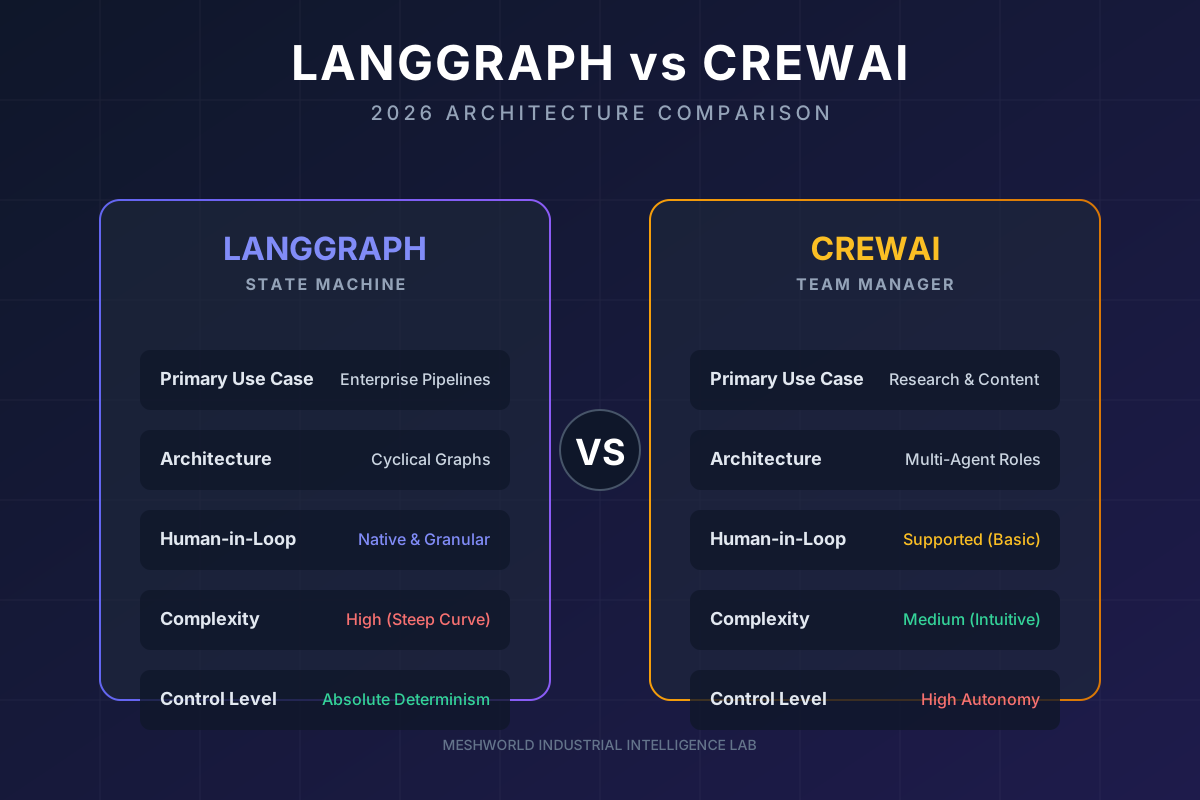
| Feature | LangGraph (LangChain) | CrewAI |
|---|---|---|
| Primary Use Case | Deterministic Enterprise Pipelines | Research & Content Collaboration |
| Architecture | Cyclical State Machine (Graphs) | Role-Based Multi-Agent Teams |
| Human-in-the-loop | Built-in, high-granularity | Supported, but less native |
| Complexity | High (Steep learning curve) | Medium (Very intuitive) |
| Control | Absolute (You define the paths) | Autonomous (Agents decide paths) |
Which One Should You Choose?
- Choose LangGraph if: You are building something mission-critical (finance, healthcare, infra) where a single hallucinated step could be catastrophic.
- Choose CrewAI if: You are building a research engine, a content pipeline, or a complex automation where you want agents to “figure it out” without you hardcoding every single edge case.
Stop overthinking it. If you’re a solo dev trying to ship a feature by Monday, start with CrewAI. If you’re an enterprise engineer building a system that needs to pass an audit, start with LangGraph.
Next Step: Once you pick a framework, you need the right tools to fuel it.
→ Read: Essential Tools and Infrastructure for Building AI Agents
Back to the main guide: AI Agents: The Complete Developer Guide
